When to use The Path spread
- Work feels stuck and you cannot tell whether the problem is the job or your approach.
- You feel overlooked and want one practical step, not a grand plan.
- A change of role, field or course is on your mind and you want to think it through.
- You are studying or between jobs and want a clearer sense of direction.
The 5 positions
- 1
Where you stand
Your working life nowStart with a snapshot of your working life today: the mood, the pace and how you feel about the work. Let this card describe the situation before you look for solutions. A tired or restless card here is useful information, not a judgment on your choices.
- 2
What blocks you
The frictionFriction shows up here: whatever slows you down or keeps you circling. It may sit outside you, like a heavy workload or a difficult team, or inside you, like doubt or a habit of waiting. Work out which kind it is before you push harder.
- 3
Hidden strength
What you overlook in yourselfThis card points to something you overlook in yourself: a skill, a quality or a resource you take for granted. Some cards name the strength directly. Others show what is covering it, such as tiredness, doubt or an unspoken worry, and the strength usually sits just behind that.
- 4
Next step
What to do nowThis is the practical card: one thing to do now. If it feels abstract, ask how its main quality would look in an ordinary working day, in an email, a conversation or an hour of focused work. A step you can picture is a step you can take.
- 5
Where it leads
If you keep walkingThe final card looks ahead to where the path leads if you keep walking the way you are going. It is a direction to weigh, not a promise. If it worries you, look again at the block and the next step, the two cards you can most directly change.
How to read The Path spread
Treat the top row as a pair of opposites with you in the middle. Where you stand sits between What blocks you and Hidden strength, and the strength often answers the block. If the block is self-doubt and the hidden strength is a skill, the proof against your doubt already exists. Settle that pairing before you look ahead.
The bottom row reads as cause and effect: the next step on the left leads to the card on the right. Check that they agree. A forceful step beside a calm final card may be asking for less push and more patience. A small step beside a bright final card suggests steady effort matters more than one big move.
The suits tell you which part of working life needs attention first. Pentacles speak to skill, money and daily work. Wands speak to drive and ambition. Swords speak to decisions, words and stress. Cups speak to how you feel about the work and the people in it. A Major Arcana card in the mix often marks a theme bigger than the job itself.
An example reading
“I feel overlooked at work. What would help me move forward?”
 1
1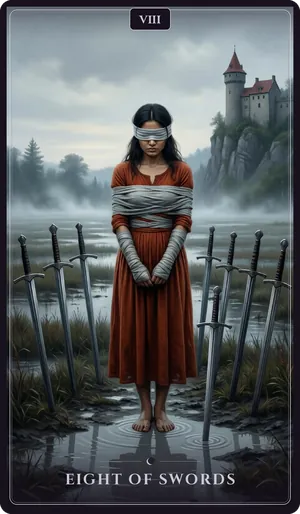 2
2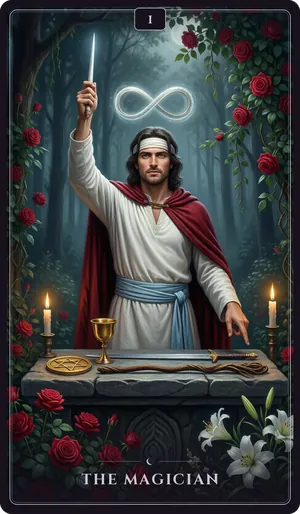 3
3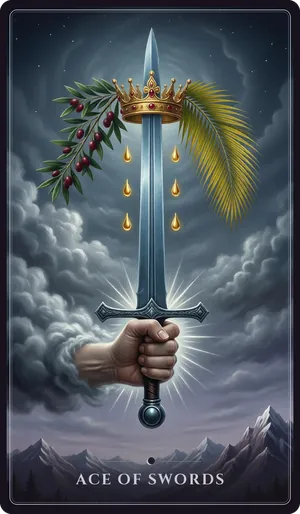 4
4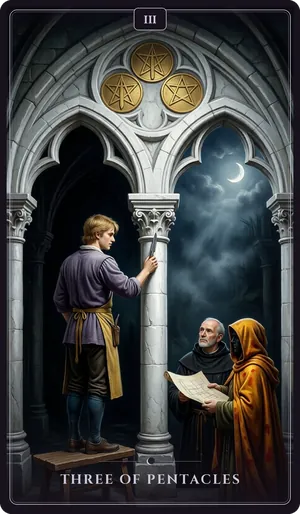 5
5- 1Where you standFour of Cups
At present, a sense of discontent is coloring how you see things. An offer or a source of support is close by, even if it does not yet feel appealing.
- 2What blocks youEight of Swords
Your own thinking is the main block. Worry and assumptions are building the walls, which means you also hold the power to take them down.
- 3Hidden strengthThe Magician
Unseen here is a reserve of skill and influence that has not been fully used yet. Someone, perhaps you, holds more power than they show.
- 4Next stepAce of Swords
Speak the truth plainly and decide with a clear head. One honest sentence will do more here than a dozen careful hints.
- 5Where it leadsThree of Pentacles
Continuing on this path leads toward excellent, recognized work and partnerships built on mutual respect. What you are building together has every chance to last.
These cards point from waiting to be noticed toward speaking up. The Four of Cups shows the mood: discontent, with an offer or some support nearby that does not yet appeal. The Eight of Swords suggests the walls are mostly worry and assumptions, which you can take down. The Magician says you hold more skill and influence than you use. The Ace of Swords gives the step: one honest sentence about what you want. The Three of Pentacles points toward recognized work and mutual respect.
Tips for reading The Path spread
- Ask about your own part. “What would help me feel valued at work?” gives you more than “Will I get promoted?”
- Give the next step a day and a time, and put it in your calendar before you close the reading.
- Write the hidden strength on a note, then look for evidence of it in the past month.
- Lay the spread again after you have taken the next step, not before, so the new reading has something to respond to.
Questions
Can a career tarot spread tell me whether to quit my job?
It can help you think, not decide for you. The Path shows what is working, what blocks you and what step fits now, which often makes the choice clearer. A decision with money or contracts attached also needs real numbers and, where it matters, professional advice. Use the reading to understand what you want.
Does The Path work if I'm a student or between jobs?
Yes. The spread covers work, studies and calling, not only paid jobs. Read Where you stand as your current situation, whether that is a course, a job search or a break. The Next step card then becomes an action for your studies or your search, such as one application or one conversation.
What does a reversed card mean in this spread?
Usually the same energy, blocked, delayed or turned inward. In What blocks you, a reversal often points to an inner block such as hesitation or self-doubt. In Next step, it often asks you to pause, rest or narrow your focus before you act. Reversals are off unless you switch them on in your profile.
How is The Path different from the Celtic Cross?
The Path is shorter and built for one area of life. Its five cards end on a next step and where it leads, which suits a work question that needs action. The ten-card Celtic Cross gives more room to a situation that touches everything at once, with its roots, its arc and the people around you.